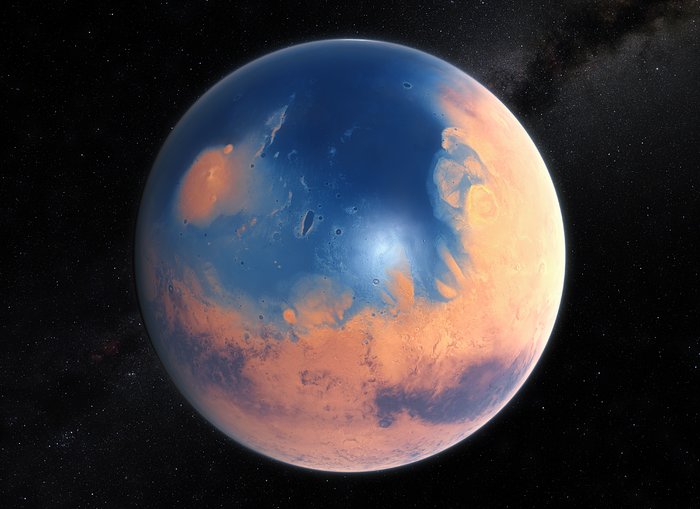
Mars today is a cold, dry desert. But, around 3.8 billion years ago, during the Noachian period, the planet showed clear signs of an active water cycle, with rivers, lakes, and even oceans which we can observe shorelines today. Yet, at that time, the Sun was only about 75% as bright as it is today, raising a fundamental question, how could Mars have been warm enough to maintain liquid water on its surface? This is the so-called “faint young Sun paradox” for Mars, and scientists have been searching for a convincing explanation for decades. One recently proposed solution involves the atmospheric stability of the CO2-rich atmosphere of Mars. The planet need other chemical species to counteracts its destruction by sunlight. Hydrogen peroxide (H2O2) is present among others to act as a catalyst, and is a molecule known for its strong greenhouse effect. The question is simple but crucial, could early Mars have produced enough H2O2 in its atmosphere to actually warm the planet enough to sustain liquid water on its surface during a long period of time?
To answer this question, numerical models are a perfect tool. The Generic Planetary Climate Model (Generic PCM) is a sophisticated three-dimensional atmospheric model including dynamics, radiative transfer, and atmospheric chemistry. The chemical reactions network incorporated was specifically designed to track down the stability of CO2 (the main component of Mars’ atmosphere), including chemistry of water vapor and hydrogen peroxide. Another key tool in this work is PaPy (Pathways analysis in Python), a Python program developed by the STESSy group member Aurélien Stolzenbach to automatically identify and analyze the dominant chemical pathways. A chemical pathways being a combination of multiple unique chemical reactions, giving a final net result. Understanding these pathways is essential because it tells us not just how much H2O2 is present, but how its abundance is controlled. PaPy allows to go beyond simply calculating reactions’ rate and to truly understand the chemistry at play in a complex, three-dimensional atmospheric setting as seen in Figure 1.
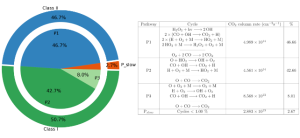
Figure 1: Contributions of the various chemical pathways in CO2 restoration. Class I pathways are the ones involving the HOx family, while class II pathways involves H2O2. Pathways whose rate is inferior to 1% are lumped together in Pslow , adding up to 2.3% of CO2 production.
The chemical pathway analysis performed by PaPy revealed that H2O2 is primarily produced through the combination of two HO2 (hydroperoxyl) radicals. However, the simulations show that the abundance of H2O2 in the early Martian atmosphere reaches only a few tens of parts per billion by volume (ppbv), far below the several parts per million (ppmv) that would be needed to produce a significant greenhouse warming. The destruction of H2O2 is rapid and efficient, driven largely by photodissociation, the molecule is broken apart by sunlight before it can accumulate to climatically relevant levels. Even in a denser, warmer early Martian atmosphere with abundant water vapor, the chemistry simply does not allow H2O2 to build up sufficiently, even taking into account dramatic events that would release a huge amount of H2O2 in the atmosphere (see Figure 2). The conclusion is clear: H2O2 alone cannot solve the faint young Sun paradox for Mars.
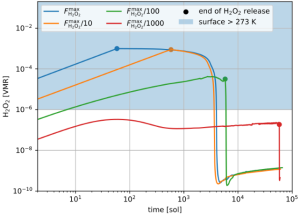
Figure 2: Time-series of the H2O2 bulk atmospheric abundances during rapid transient H2O2 release events associated with the evaporation of a 550 meters thick ice cover on Mars. The fastest melting rate is the blue curve yielding a high flux of H2O2 in the atmosphere during 58 sols (a sol being one Martian day).The orange, green, and red curves represents a lower H2O2 release flux but during a longer period of time, as seen by the plain dots, representing the end of H2O2 release by the melting of the ice cover. The shaded light blue area represent the amount of H2O2 necessary to have a surface temperature higher than 273K, hence liquid water at the surface. As this figures shows, H2O2 is not sufficient enough to sustain over large period of time liquid water on the surface of early Mars. The abundance of H2O2 decreases rapidly after rapid release events.
This study does not close the door on the mystery of early Mars, but it does firmly rule out hydrogen peroxide as the sole warming agent. Other greenhouse gases and other warming mechanisms, such as the CO2-H2 collision induced absorption or high altitude cloud coverage, remain active candidates. The work also demonstrates the power of combining three-dimensional climate modeling with detailed chemical pathway analysis tools like PaPy to study the atmospheres of other planets as well. As new missions continue to reveal more about Mars’ ancient past, having robust modeling tools will be essential to test new hypotheses. The faint young Sun paradox for Mars still remains one of the most fascinating open questions in planetary sciences.
The paper about the warming of the early Mars atmosphere is available with the link Maurice, Maxime, et al. “Not enough H2O2 to warm early Mars.” Icarus (2025): 116914.
Credit of artist’s impression of Mars in the Noachian period: ESO/M. Kornmesser/N. Risinger