
When the Rosetta spacecraft imaged the nucleus of comet 67P/Churyumov-Gerasimenko, the appearance was seen to vary significantly across the surface: some areas showed rock-like, exposed solid material, while others appeared to be coated in a blanket of dust. Subsequently, researchers understood the dust covering to consist of particles ejected by the comet’s own activity but without sufficient velocity to escape into the coma and tail, and which then fell back onto the surface. The location of the fallback was then clearly connected to the activity mechanism and the comet’s seasons, but the precise distribution and connections between different areas remained unknown.
In a recent paper with STESSy involvement (through researcher Nicholas Attree), significant steps have been taken to improve our knowledge. A model of ballistic transport of dust particles, ejected from every surface facet of a 67P shape model, was used to determine the pathways connecting different areas of the surface. The ejection probability was scaled by an overall activity level determined in previous work (also with STESSy involvement, see https://stessy.iaa.es/how-hot-is-67p/), in order to simulate the stronger activity found in 67P’s southern than northern hemispheres. Particles were allowed to ‘hop’ multiple times to simulated re-ejections, and the simulations run many times to reach a converged, average distribution of fallback over the surface.
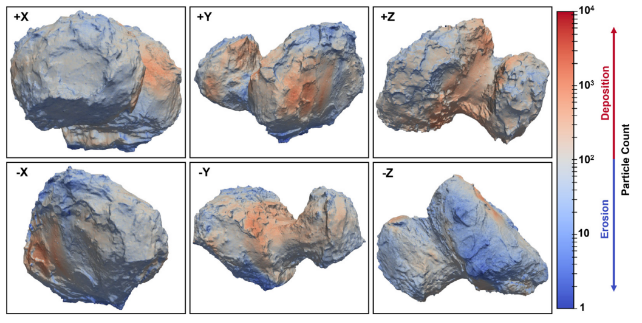
Figure 1 shows the global distribution of fallback particles at the end of the simulation for moderate ejections velocities ( 0.5 ms−1). Here the overall north-south divide in dusty terrains seen by Rosetta is reproduced, while specific areas, associated with the comet’s rotation, receive even more particles as the comet ‘sweeps’ them up, while shadowing other areas.
Fig. 1. Global sediment redistribution at moderate ejection velocity. Results of simulations initialized with ∼100 particles per facet, showing the number of particles remaining on each facet of 67P’s shape model after 10 hops at an ejection velocity of 0.5 ms−1. At this velocity, sediment transport transitions from locally confined motion to near-global redistribution driven primarily by the comet’s shape and rotation.
Agreement was also found between the distribution of fallback particles and that of dusty terrain between, and within, the regions defined on 67P’s. Figure 2 shows the Imhotep region as an example.
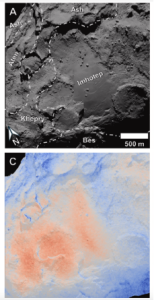
Fig. 2. Top: Rosetta image of the Imhotep region of 67P, with region boundaries overlaid. Bottom: particle density map at the end of simulations of 0.5 ms−1 ejections, showing agreement between the ‘dusty’ western parts (left) and more ‘rocky’ eastern (right) parts.
On some areas of the nucleus, the model did not reproduce exactly the observed dust covering, and this will be explored in subsequent work, incorporating a time-dependent ejection probability to improve the fidelity of the model.
The study was led by Abhinav Jindal of Brown University, USA as part of an ongoing NASA-funded project on cometary activity. Nicholas Attree contributed to algorithm development and interpretation of the results during a week-long working trip to the Obseratoire de Cote d’Azur, France, hosted by co-author Raphael Marschall.
The paper “The paths that sculpt a comet: Quantifying the sediment trajectories shaping 67P’s landscapes”, lead author Abhinav Jindal, is published in Icarus here https://www.sciencedirect.com/science/article/pii/S001910352600165X?via%3Dihub