
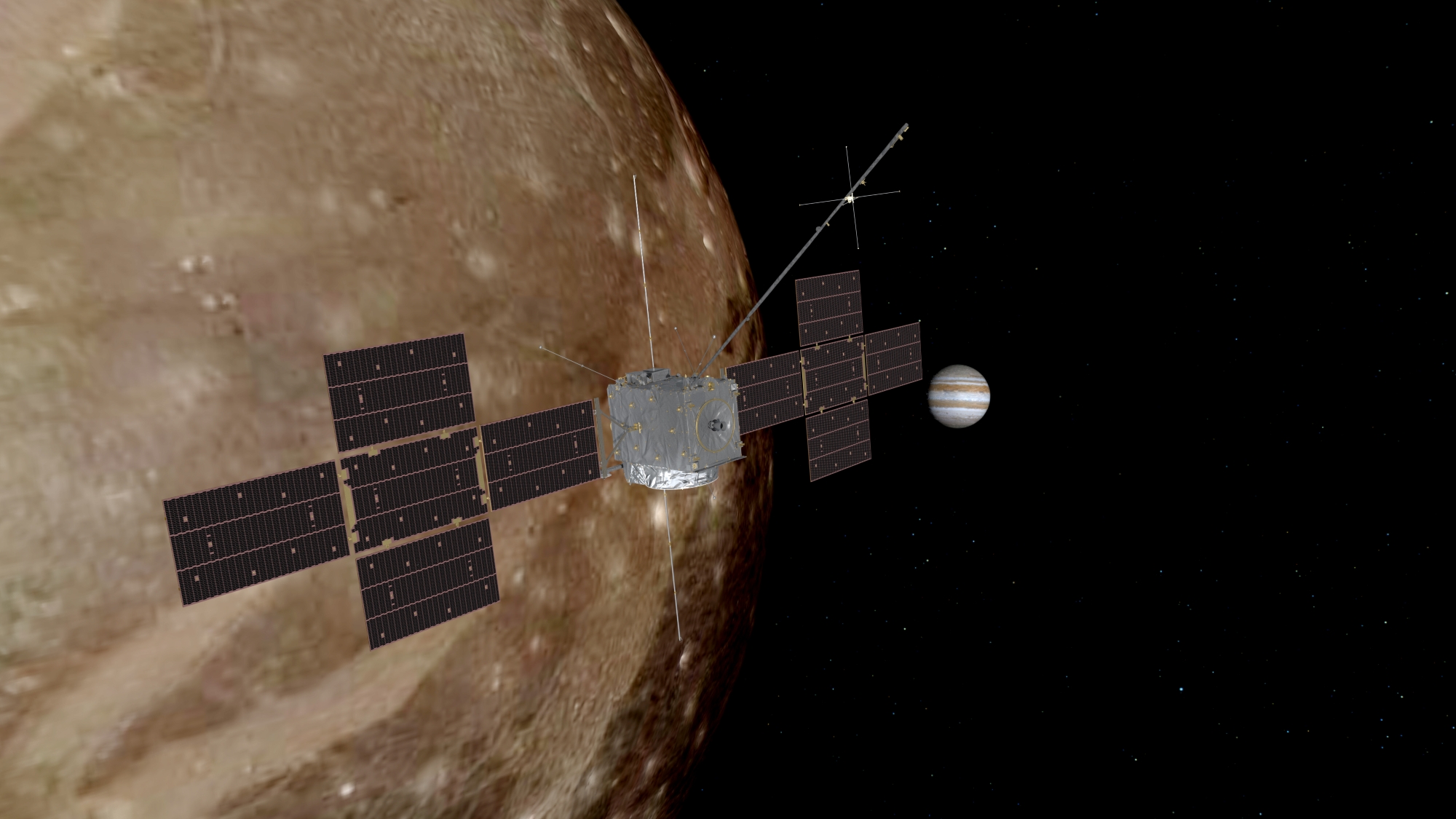
An international team led by Juan Luis Rizos, a member of our group, has unveiled the first detailed portrait of Kallichore, one of Jupiter’s smallest and most elusive moons, opening the door to a possible close encounter by ESA’s JUICE spacecraft.
Among Jupiter’s more than one hundred known moons, Kallichore has spent over two decades hiding in plain sight.
Discovered in 2003, this tiny irregular satellite is only a few kilometres across and lies so far from Earth that, until now, astronomers could only see it as a faint point of light. But thanks to an international observing campaign led by our colleague Rizos, Kallichore has finally revealed its true identity.
Published in Nature Astronomy, the study presents the first complete physical characterisation of the satellite, determining its size, shape, brightness and orbit with unprecedented precision. More importantly, it turns Kallichore into a realistic candidate for one of the most exciting opportunities of ESA’s JUICE (JUpiter ICy moons Explorer) mission: a close flyby during its tour of the Jovian system.
A messenger from the Solar System’s infancy
Unlike Jupiter’s large icy moons, irregular satellites are thought to be ancient objects captured by the giant planet billions of years ago. They are, in many ways, time capsules that preserve information about the earliest stages of Solar System formation.
To unlock Kallichore’s secrets, the team combined observations from the Hubble Space Telescope, the Gran Telescopio Canarias, and a worldwide stellar occultation campaign coordinated and led by Rizos. Together, these observations transformed a barely visible dot into a well-characterized world.
Studying such a tiny object is anything but straightforward.: trying to characterize Kallichore from Earth is roughly equivalent to distinguishing a one-euro coin in Moscow while standing in Córdoba. Yet, despite this extraordinary challenge, the new observations provide the most accurate description ever obtained for one of Jupiter’s smallest moons.
Why does this matter for JUICE?
JUICE is currently travelling towards Jupiter, where it will investigate the giant planet and its icy moons. A flyby of Kallichore has long been considered scientifically attractive, but one major obstacle stood in the way: nobody knew its orbit accurately enough to plan the observations.
Before this work, the uncertainty in Kallichore’s predicted position exceeded 1,500 kilometres. The new study reduces that uncertainty by more than 80%, down to only 260 kilometres, a level of accuracy that finally makes detailed mission planning possible.
These new measurements allow us to evaluate Kallichore much more reliably as a potential target for JUICE and maximise the scientific return of a possible encounter. The results also provide the information needed to optimise observations by several JUICE instruments—including JANUS, MAJIS, UVS and SWI—whose performance depends on accurately knowing the satellite’s size, brightness and trajectory.
The beginning of a new exploration story
ESA has not yet decided whether JUICE will fly past Kallichore. But thanks to this work, mission planners now have the information needed to evaluate that possibility.
If approved, the encounter would become the first close exploration ever performed of one of Jupiter’s tiny irregular moons, offering a unique glimpse into one of the Solar System’s oldest surviving building blocks.
Sometimes, the biggest discoveries begin with the faintest point of light.
Rizos, J.L., Gómez-Limón, J.M., Kilic, Y. et al. Kilometre-scale Jovian moon characterized for a potential JUICE flyby. Nat Astron (2026). https://doi.org/10.1038/s41550-026-02929-z