
A new study led by Juan Luis Rizos, member of the STESSy group, reveals that a large smooth structure observed on comet 9P/Tempel 1 may have formed as recently as 600 to 1,200 years ago. This timeframe notably coincides with a period of abrupt orbital changes caused by multiple close encounters with Jupiter (Fig. 1), which we propose may have triggered a cryovolcanic event, although the underlying mechanism remains unknown.
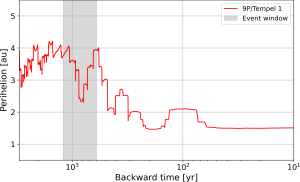
Fig. 1. Data from Ip et al. (2016) showing the past orbital evolution of 9P/Tempel 1 over the last 3,000 years. The shaded area marks the interval between 1,200 and 600 years ago, corresponding to our estimated formation period of the large smooth patch. Notably, this timeframe coincides with the most abrupt orbital changes, during which the perihelion decreased from ~4 to 2.3 au before returning to ~4 au.
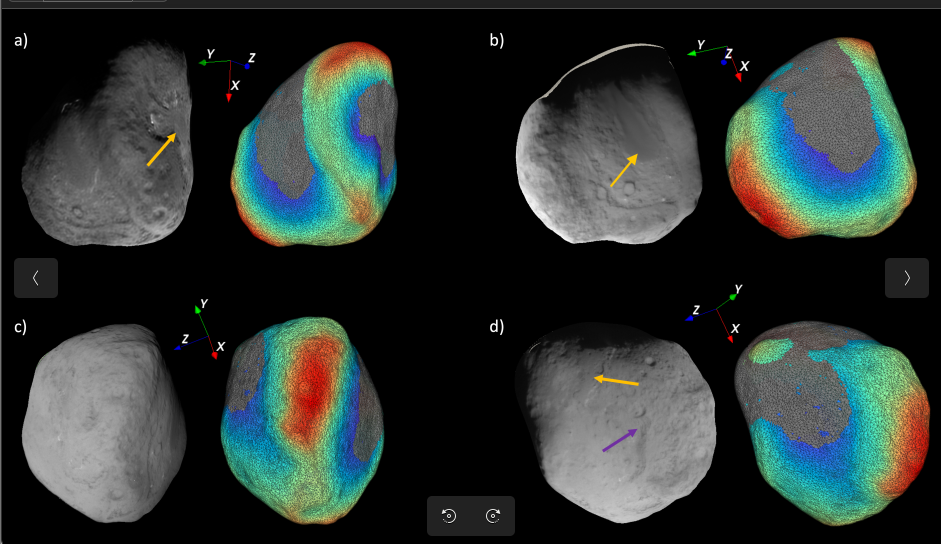
Through simulations, we demonstrate that a single episode of material displacement could explain not only this large smooth region, but also other similar areas on the comet (Fig. 2).
Fig. 2. Deep Impact and Stardust-NExT images are shown alongside our simulation of surface flow on comet 9P/Tempel 1, reoriented to match the viewing geometry for direct comparison. In the synthetic images, the blue-to-red color scale indicates gravitational potential (blue marks potential wells), while gray facets represent the simulated flow region. In panel (a), the orange arrow marks the equatorial smooth unit. In panel (b), the orange arrow points to the large smooth patch, the main focus of this work. In panel (d), the orange arrow indicates the northern smooth unit, while the purple arrow highlights terraces with up to five distinct steps. The simulation links all smooth units and mass-wasting features on the northern face as the outcome of a single event.
The work, accepted for publication in The Planetary Science Journal, reanalyzes data from the Deep Impact and Stardust-NExT NASA space missions, together with high-resolution shape models of the comet. The results show that this region, extending over more than 2.5 km, is about 25 meters thick and displays a characteristic U-shaped morphology, consistent with a lobate shape produced by material flow. The team carried out a detailed analysis of the structure, including the generation of stereo anaglyphs to visualize its three-dimensional geometry.
Unlike other comets, such as 67P/Churyumov–Gerasimenko, where smooth areas are typically thin, short-lived, transient deposits, this structure appears to be much thicker and more stable. Our analysis indicates that its composition is similar to that of the surrounding terrain, pointing to an internal origin of the material.
This finding suggests that the evolution of cometary morphology is not driven solely by solar activity, but also by gravitational interactions with giant planets, opening new avenues for understanding the geological history of these primitive bodies in the Solar System.
The paper, available at https://doi.org/10.3847/PSJ/ae64ea, was published in The Planetary Science Journal on 26 May 2026.