Venus, often called Earth’s “evil twin,” hosts a thick, cloud-covered atmosphere dominated by carbon dioxide with traces of sulfur dioxide (SO2), water vapor, and other minor species. Its extreme conditions, including crushing pressure, scorching temperatures, and opaque sulfuric acid clouds, make observations challenging. To unravel this atmospheric complexity, members of the STESSy group use the Venus Planetary Climate Model (PCM), a 3D global climate model that couples photochemistry and cloud microphysics for the first time. Here, we post the work led by Aurélien Stolzenbach in collaboration with researchers in France.
Sulfur dioxide is the key gas in the planet’s sulfur cycle because it is the parent species of the clouds’ main constituent, sulfuric acid (H2SO4). While it is abundant in the lower atmosphere, it is mysteriously depleted in the clouds, losing more than 99% of its abundance. The clouds of Venus play a central role in this mystery. Composed of sulfuric acid droplets, they form a thick layer of condensed H2SO4 and water vapor. The Venus PCM explicitly simulates the condensation and evaporation of these droplets, assuming they are in thermodynamic equilibrium. However, the model still cannot account for the sharp depletion of SO2 without artificially lowering its initial abundance in the deep atmosphere. This workaround highlights the lack of a confirmed mechanism for the bulk depletion of sulfur dioxide. Nonetheless, the Venus PCM was able to reproduce the vertical profiles and proportions of condensed H2SO4 and H2O in the clouds in good agreement with available observations. These results match the droplet number density recorded during the Pioneer Venus era and the cloud acidity measurements from the Venus Express mission. This suggests that the SO2 depletion might originate from a mix of unidentified processes happening in a very shallow altitude range just below the cloud deck.
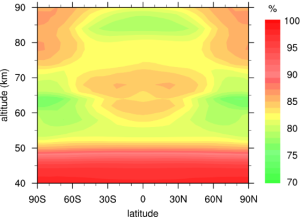
Figure 1: Venusian clouds’ acidity (the ratio of H2SO4 in the droplet) modeled by the Venus PCM. The model reproduces the very acidic lower cloud region (around 50 km) and the decrease of acidity with altitude quite well
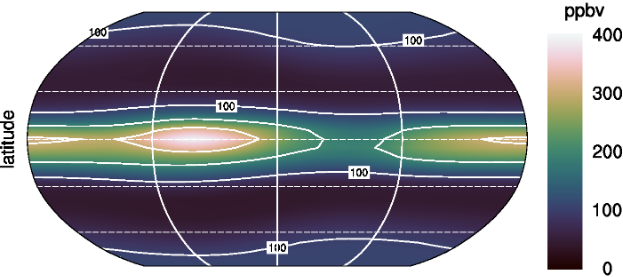
The Venus PCM is also a unique tool, as it is the only 3D model currently available for the chemistry of Venus. It allows us to study the diurnal and latitudinal variations of key chemical species. For instance, the dynamics of the Venusian middle atmosphere are governed by super-rotation (extreme westward winds in the cloud deck) and the planetary Hadley cell. Both of these dynamical mechanisms affect the latitudinal and vertical behavior of chemical species. Long-lived species like carbon monoxide and sulfur dioxide show how 3D transport, driven by the combined effects of the Hadley cell and super-rotation, sculpts abundances in the middle atmosphere. In addition, the photochemistry and cloud module provides an unprecedented theoretical picture of the Venusian atmosphere, as seen in Figure 2.
Figure 2: Map of the SO2 volumic mixing ratio (in part per billions) at 70 km of altitude centered at local noon. The maximum of SO2 abundance in the equator is due to the raising equatorial branch of the Hadley cell while its shifting to the west comes from the intense westward winds. The enrichment at high latitudes (above 60ºN and S) are the results of the downward brach of the Hadley cell, moving SO2-rich air parcels from altitudes above. We can also identify the wave pattern in the high latitudes region originated from the diurnal thermal tides.
Solving the mysteries of the Venusian atmosphere will likely require collaboration between modelers and future missions to bridge the gap between theory and observation. One such effort is the ESA-led mission EnVision, planned to launch in Autumn 2031, which includes the suite of three spectrometers named VenSpec. Developed with technical and scientific involvement from the STESSy group, these instruments aim to measure the key chemical species in the middle atmosphere of Venus, including SO2.
The paper about the Venus PCM results is available with the link Stolzenbach, Aurélien, et al. “Three-dimensional modeling of Venus photochemistry and clouds.” Icarus 395 (2023): 115447.